
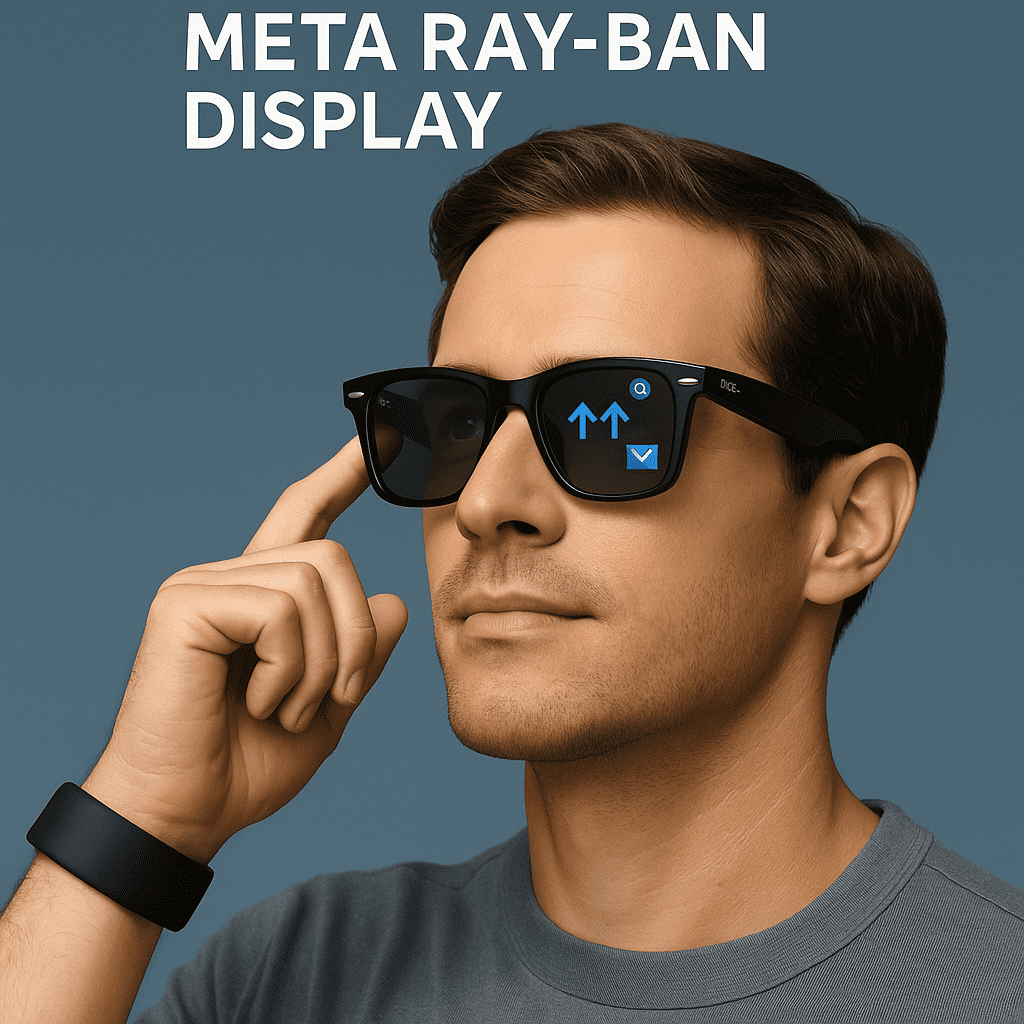
Meta has officially unveiled its latest innovation in wearable technology — the Ray-Ban Display smart glasses. Announced by CEO Mark Zuckerberg at Meta Connect 2025, these next-generation smart glasses combine stylish Ray-Ban frames with an integrated display and an AI-powered wristband controller.
Launching September 30, 2025 for $799, the new Meta Ray-Ban Display is positioned as a direct step toward making smart glasses a mainstream replacement for smartphones.
Key Features of Meta Ray-Ban Display
- Built-in display on the right lens: Show apps, alerts, directions, and translations.
- Meta Neural Band controller: A wristband that picks up subtle hand gestures using EMG signals.
- Onboard AI assistant: Supports Instagram, WhatsApp, Facebook, and more.
- Cameras, speakers, microphones: Hands-free content creation and voice interaction.
- Cloud connectivity: Access to social media, navigation, and real-time translations.
- Battery life: Neural Band offers 18 hours of usage and is water-resistant.
👉 Related: Meta Quest VR Headsets | Best AI Wearables 2025
Meta Neural Band: A New Way to Control Devices
The Neural Band looks like a sleek, screenless Fitbit but is packed with advanced electromyography (EMG) sensors. These sensors detect signals from your brain to your hand, enabling precise gesture-based control.
This is Meta’s bet on a post-touchscreen era, where AI-powered wearables replace smartphones for daily tasks like messaging, navigation, and translation.
Meta Ray-Ban Display vs. Orion Smart Glasses
At Meta Connect 2024, Meta showcased Orion, a more advanced prototype featuring AR lenses and eye tracking. However, Orion remains a long-term project, while the Ray-Ban Display is ready for consumers today.
- Ray-Ban Display: Practical, stylish, consumer-ready, $799.
- Orion: Advanced AR features, not yet available to the public.
Meta’s Strategy: Competing With Apple & Google
Meta has already sold millions of Ray-Ban Meta smart glasses in partnership with EssilorLuxottica. With this launch, the company is doubling down on AI-powered wearables to reduce its reliance on Apple and Google hardware.
However, analysts expect Apple smart glasses and Google AR wearables to enter the market soon, integrated directly into their OS ecosystems — a potential challenge for Meta’s adoption strategy.
👉 Recommended Reading: Apple Vision Pro Updates | Google AR Glasses Rumors
What to Expect at Meta Connect 2025
- Meta Ray-Ban Display launch (Hypernova codename).
- Oakley Spheara AI smart glasses designed for athletes.
- Possible updates on Meta Superintelligence Labs (MSL).
- Future roadmap for Meta Quest VR headsets.
Zuckerberg is expected to highlight how AI wearables + contextual computing will transform the future of interaction.
How to Watch Meta Connect 2025
- 📍 Location: Menlo Park, California
- 🗓 Date: September 17, 2025
- ⏰ Keynote: 5 p.m. PT by Mark Zuckerberg
- 📺 Livestream: Available free on Meta’s website and Facebook via Meta for Developers.
- 🥽 VR Experience: Watch inside Horizon with your Meta Quest headset.
Developer sessions will continue on Thursday, including a talk on the future of glasses with contextual AI by Meta Reality Labs executives.
Final Thoughts: Can Meta Win the Smart Glasses Race?
Meta is positioning the Ray-Ban Display smart glasses as the first widely available AI-powered wearable that blends fashion with functionality. While they may not match the futuristic capabilities of Orion, they mark an important step in making smart glasses a mainstream consumer product.
Whether Meta can outpace Apple’s AR glasses or Google’s wearable AI devices remains to be seen. But with strong partnerships (Ray-Ban, Oakley) and billions invested in Meta Superintelligence Labs, the company is betting big on an AI-first, wearable future.
👉 Next Read: Meta’s AI Superintelligence Labs Explained | Best Smart Glasses of 2025 Compared
Display optics in daylight, not just keynote darkness
Micro-OLED projections in lens stacks fight ambient glare differently than phone screens with brightness cranked to max. Outdoor readability depends on coating choices, frame geometry, and how much contrast survives when you are not standing in a dim demo hall. Reviewers who test only indoors miss the failure mode commuters care about: navigation prompts washed out on a sunny sidewalk.
Try reading notifications at noon before assuming the display replaces pulling out your phone for every glance.
Neural band input is a learned skill
Temple taps on earlier Ray-Ban Meta glasses were imperfect but familiar. A neural band introduces a new motor vocabulary—subtle finger gestures mapped to UI actions—that users must practice until muscle memory forms. Early adopters tolerate learning curves; mainstream buyers return products that feel flaky on week one.
Onboarding flows should include calibration, failure recovery, and clear feedback when the band misreads a gesture—otherwise support forums fill with "broken" hardware that is untrained input.
Privacy for bystanders and local recording laws
Visible recording LEDs help signal capture to people nearby, but audio recording raises separate legal questions in two-party consent regions. Smart glasses that feel personal still project a surveillance aura in gyms, classrooms, and workplaces with no-device policies. Employers updating acceptable-use policies should address eyewear explicitly, not only phones on tripods.
Meta's privacy toggles matter only if users enable them; defaults and UI friction shape real-world behavior more than blog posts.
Battery life when features stack
Music playback alone lasts longer than navigation, live captions, and camera clips chained on one commute. Charging cases become daily carry items, not emergency backups. Thermal limits may throttle brightness or frame rates during summer rides—thin temples lack phone-scale heat spreaders.
Plan battery assumptions around your heaviest feature combo, not the best-case spec sheet line.
Software ecosystem and vendor lock-in
Features tie to Meta accounts, companion apps, and regional service availability. If you switch ecosystems or travel where services are limited, glasses may downgrade to audio-only eyewear. Developers building on Meta's APIs should track deprecation policies—hardware longevity outlasts social platform feature experiments.
Who should wait versus buy early
Buy early if you document field work hands-free, want to prototype lightweight AR UX, or tolerate beta-grade quirks. Wait if you need all-day display use, work in strict no-recording venues, or expect prescription lenses plus display without compromise. The category is real; the v1 tradeoffs are equally real.
Compare return windows and lens replacement costs before treating smart glasses as everyday replacements for standard frames.
Prescription lens logistics
Smart glasses buyers needing progressive lenses should confirm optician partners and lead times before buying frames—display models may delay weeks longer than standard Ray-Ban orders.
Developer preview limits
API access for smart glasses apps remains invite-heavy—startups should not plan revenue on display SDK availability dates from keynotes alone.
Workplace acceptable use
Employers updating AUP for smart eyewear should address recording in open offices and client sites—HR templates lag hardware launches unless security teams draft addenda now.