
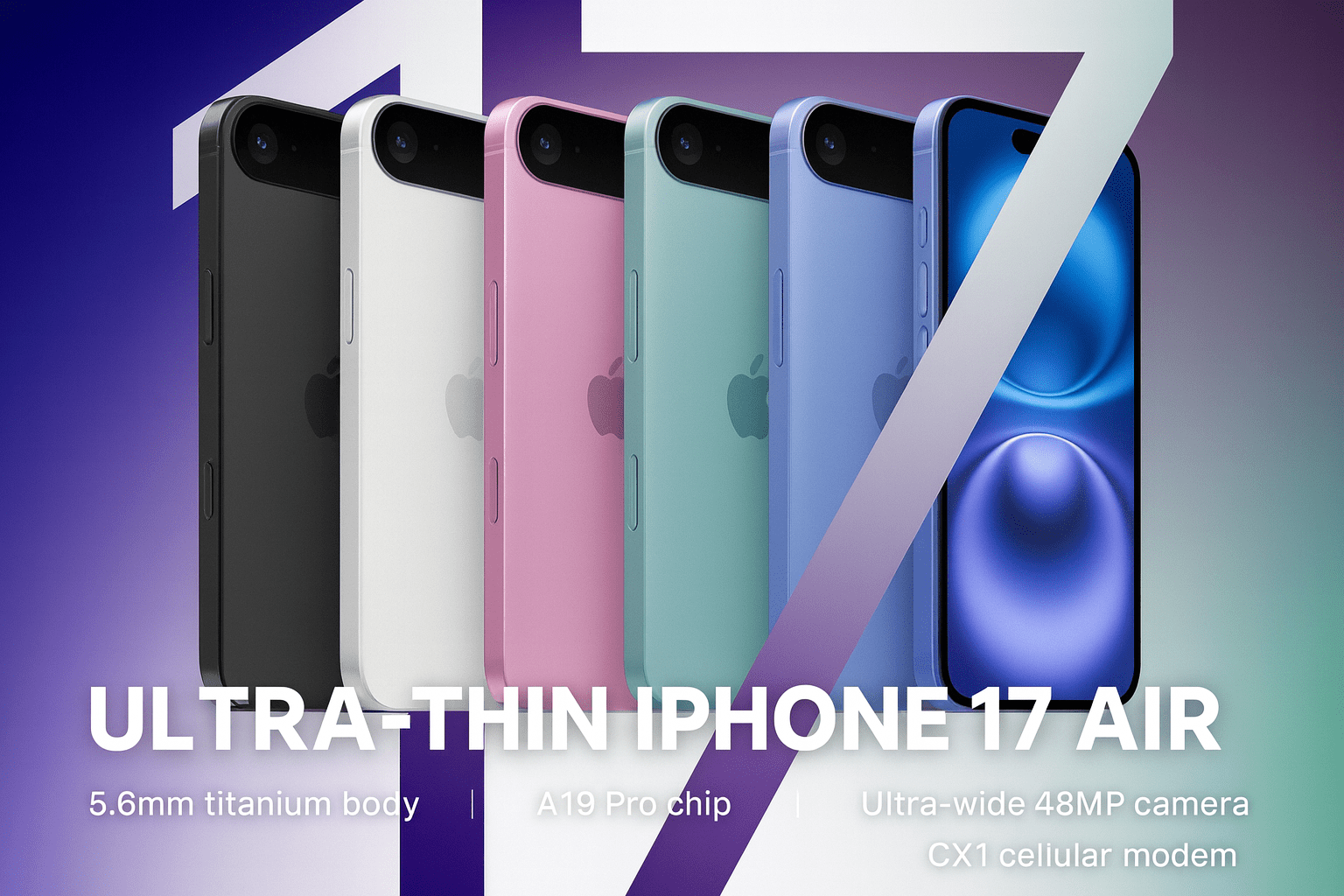
Apple has officially launched its much-anticipated iPhone 17 lineup, including the brand-new iPhone Air. This year’s series delivers major upgrades, thinner designs, and premium features that were once exclusive to the Pro models. Here’s everything you need to know.
iPhone 17: More Power, More Features
The base iPhone 17 may look similar to the iPhone 16, but it finally gets long-awaited upgrades.
- 6.3-inch ProMotion display with a 120Hz refresh rate and always-on mode
- A19 chip with better CPU and GPU performance
- N1 networking chip for Wi-Fi 7, Bluetooth 6, and faster AirDrop
- 18MP front camera with Center Stage and improved low-light selfies
- 48MP main + 48MP ultra-wide cameras
- New Ceramic Shield 2 for stronger scratch and glare resistance
Colors: Lavender, Mist Blue, Sage, White, Black
Starting Price: $799
iPhone Air: Apple’s Thinnest iPhone Ever
The all-new iPhone Air is Apple’s boldest design shift since the iPhone X.
- Ultra-thin titanium body (just 5.6mm at its slimmest)
- 6.5-inch ProMotion display with always-on support
- A19 Pro chip + new CX1 modem for faster, energy-efficient connectivity
- 18MP Center Stage front camera
- Single 48MP rear camera
- Ceramic coating on both sides for durability
Colors: Space Black, Cloud White, Light Gold, Sky Blue
Starting Price: $999
iPhone 17 Pro & Pro Max: The Flagship Experience
For power users, Apple is pushing boundaries with the Pro models.
- Thermally conductive aluminum unibody with vapor chamber cooling
- 6.3-inch (Pro) / 6.9-inch (Pro Max) ProMotion display
- Peak brightness up to 3000 nits
- Triple 48MP camera array for pro-level photography
- 18MP Center Stage front camera
- Storage up to 2TB
Colors: Blue, Orange, Silver (two-tone design)
Starting Prices: $1,099 (Pro), $1,119 (Pro Max)
Pricing & Release
- iPhone 17: From $799 (256GB)
- iPhone Air: From $999 (256GB)
- iPhone 17 Pro: From $1,099 (256GB)
- iPhone 17 Pro Max: From $1,119 (256GB)
Pre-orders begin Friday, September 13 at 5 AM PT, with full retail availability on September 20.
Suggested AdSense Placements:
- Top of article (below headline) → High CPM display ad.
- Between iPhone 17 and iPhone Air sections → In-article ad for strong engagement.
- End of article (above pricing & release) → Responsive display ad.
- Sidebar (if theme supports) → Sticky banner ad for consistent visibility.
Who each SKU is actually for
The base iPhone 17 remains the volume play for upgraders coming off iPhone 13 or older devices who want modern cameras and USB-C without financing a Pro telephoto stack. The Air model targets people who care about pocket feel and one-handed use but refuse to buy last year's Pro just for thinness. Pro and Pro Max buyers are still the creators, mobile gamers, and business travelers who lean on optical zoom, ProRes, and the largest battery Apple ships in a phone.
If you shoot mostly in daylight and share to social apps, the base sensor improvements may satisfy you more than the Pro periscope lens you never open. If you edit 4K video on the phone or shoot concerts from the upper bowl, the Pro Max zoom and microphone array remain the rational pick even when the Air looks more fashionable in photos.
Camera pipeline differences that keynote slides compress
Apple's Photonic Engine and multi-frame fusion still differ by tier. The Pro models retain faster aperture telephoto modules and LiDAR-assisted low-light portraits that the Air omits to save thickness. Night mode on the ultrawide is not identical across SKUs—compare sample galleries shot at dusk, not studio demos.
Video creators should test Action mode and spatial audio capture on the tier they plan to buy. Thermal throttling during long 4K60 clips shows up sooner on thinner chassis. If you livestream from a gimbal for an hour, the Pro Max heat spreader matters more than an extra millimeter of bezel.
Battery, charging, and the thin-phone trade
The Air's slim profile trades internal volume for milliamp-hours. Real-world screen-on time gaps appear on travel days with weak LTE and brightness pinned high—not in Apple's scripted playback tests. MagSafe charging speeds and heat while fast-charging also vary; a thin phone against a warm car dashboard degrades faster than a thicker Pro with more thermal headroom.
Check whether your daily routine is desk-heavy with top-ups or airport-heavy with one long unplugged block. That answer should drive SKU choice more than colorway marketing.
Band lists, eSIM-only markets, and import buyers
Regional SKUs still diverge on 5G bands and satellite messaging availability. Canadians and Europeans importing US models should verify home-carrier compatibility tables before assuming keynote 5G claims transfer. Some markets ship eSIM-only without a physical tray; travelers who swap local SIMs at borders need to confirm dual-eSIM behavior on the exact model number printed on the box.
Enterprise buyers on DEP or ABM should align MDM profiles with the OS version preloaded on launch units—carrier-branded SKUs sometimes lag clean builds by a point release.
Repairability and ownership cost
Apple's repair pricing for back glass and display assemblies still steps up sharply between base and Pro tiers. AppleCare+ versus self-insuring depends on how often you crack screens in field work. The Air may cost more to repair proportionally if thin structures fail in drop tests you actually experience, not lab anecdotes.
Trade-in values for iPhone 15 Pro Max units can narrow the upgrade delta if you time a carrier promo window. Run the math with tax and financing APR included; zero-percent installment marketing hides in the footnotes.
Upgrade checklist from iPhone 14 or 15
- List the three apps that drain your current battery before noon.
- Count how many photos in your camera roll used telephoto beyond 3x last month.
- Confirm whether USB-C accessories you already own need a new cable rating for fast transfer.
- Check if your employer requires hardware attestation features tied to a specific Secure Enclave generation.
- Decide if satellite roadside features matter where you drive without signal.
If fewer than two checklist items point to Pro hardware, the base 17 or Air likely covers your next two years without buyer's remorse.
What to watch in the first sales month
Pre-order shipping estimates for Pro colors are the earliest hard signal on supply constraints. Carriers pushing Air upgrades with bill credits may shift average selling price without changing unit headlines. Accessory attach rates at pickup—cases, MagSafe wallets, AirPods bundles—feed margin models analysts update the Monday after launch weekend.
Enterprise DEP shipments often lag consumer queues; B2B volume smooths launch spikes but can move revenue recognition into the next fiscal quarter. None of that invalidates the product story—it just explains why stock and supply headlines diverge from your local store experience.